Super Smash (replica)
1 language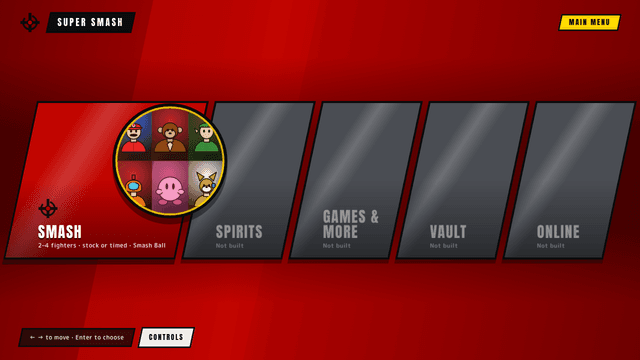 | |
| Screenshot of the Super Smash replica's main menu | |
| Type | Fighting game |
|---|---|
| Replica of | Super Smash Bros. Ultimate |
| Developer | David |
| Written in | Next.js, WebRTC rollback netcode, Q12 fixed-point simulation, seeded PRNG inside GameState |
| Tests | 1,285 unit/property tests, 7 e2e |
| Built with | Eight research lanes, frozen engine contract, six build slices |
| Repository | ../super-smash |
| Website | https://smash-david.vercel.app |
Super Smash (replica) is a browser rebuild of Super Smash Bros. Ultimate's versus mode, developed in the super-smash folder of the Replicates repository. It implements 8 of the original game's 89 fighters, chosen to span different fighter archetypes.
Every fighter is drawn entirely from code, as a bone hierarchy of capsules and circles, with no assets taken from Nintendo; every sound is synthesised from oscillators rather than sampled.
Overview
The replica's knockback equation matches Ultimate's own, stage geometry is sourced from Kurogane Hammer's published frame-data reference,[1] and frame data is drawn from decompiled game scripts.
Architecture
Unlike the original, which is delay-based, the replica adds rollback netcode over WebRTC. The game simulation runs in Q12 fixed-point arithmetic with a seeded pseudo-random number generator held inside its GameState, and a layering test fails the build outright if Math.random, Date.now, or any transcendental Math function is used inside the engine. Netcode is tuned to 2 frames of input delay with an 8-frame prediction cap; a shared-WiFi LAN path required no additional code, relying on ICE host candidates.
Development
The replica carries 1,285 unit/property tests, 7 e2e, and was built across eight research lanes, frozen engine contract, six build slices, developed against a frozen engine contract.
Reception
The rollback implementation was verified against a ground-truth run across six network link conditions, including one with up to 150 ms of latency and 40 ms of jitter, recording 82 rollbacks over the course of testing.
See also
References
- ^ “Stage Data.” Kurogane Hammer. kuroganehammer.com.
- ^
super-smash/README.md.
- Software replicas
- Fighting games
- Browser games