Fake Phone
1 language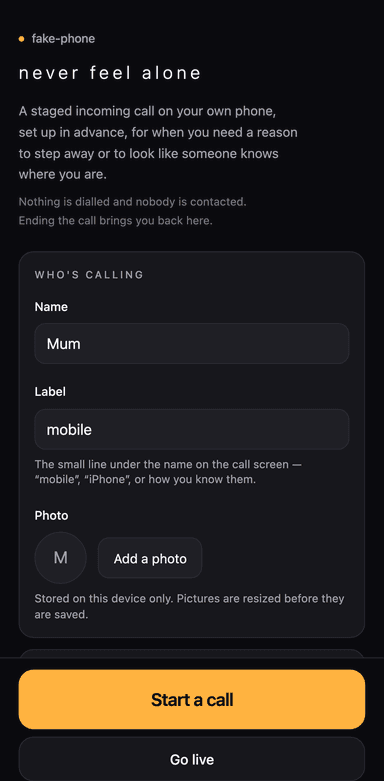 | |
| Screenshot of the Fake Phone replica's home screen | |
| Type | Personal-safety web application |
|---|---|
| Replica of | the iOS and Android incoming-call screen |
| Developer | David |
| Written in | Next.js, installable PWA |
| Tests | 363 unit tests, 89 e2e |
| Built with | Six research lanes, six build slices |
| Repository | ../fake-phone |
| Website | https://fake-phone-david.vercel.app |
Fake Phone is a personal-safety web application, developed in the fake-phone folder of the Replicates repository, that replicates the incoming-call screens of iOS and Android alongside a live-stream mode that uses the device's real camera.
The application opens directly into a ringing call; ending that call is the only way to reach its settings, which also gives the settings screen social cover in front of another person.
Overview
The app offers three voice tiers for the simulated caller: Silent, Scripted (the default), and an AI tier that is fully wired but remains completely inert without an API key, falling back silently rather than getting stuck on a “connecting” state. It is installable as a progressive web app.
Design and platform constraints
The project documents its platform limits candidly rather than hiding them: mobile Safari suspends JavaScript timers when the device is locked, capping usable ring time at 60 seconds, and iOS exposes no vibration API to the web. Apple's App Store Review Guideline 1.1.6, which bans “prank call” apps,[1] is treated as a hard constraint on all of the product's language and framing.
Development
The replica carries 363 unit tests, 89 e2e, run across mobile Safari, mobile Chrome and desktop, and was built across six research lanes, six build slices.
See also
References
- Software replicas
- Personal safety software
- Progressive web applications