Dollar Pixels
1 language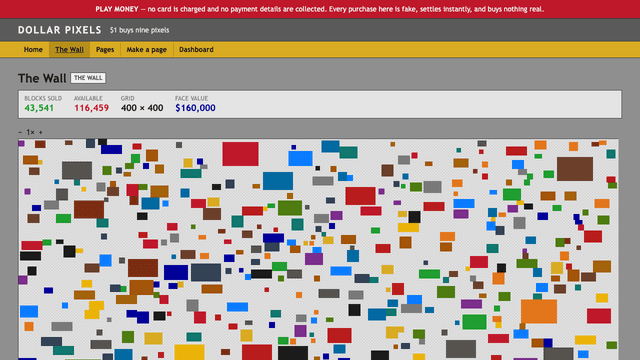 | |
| Screenshot of the Dollar Pixels replica's pixel wall | |
| Type | Advertising / novelty website |
|---|---|
| Replica of | The Million Dollar Homepage |
| Developer | David |
| Written in | Next.js, canvas renderer with O(1) hit-testing, Stripe (one env var away) |
| Tests | 414 unit/property tests, 30 e2e |
| Built with | Five research lanes, five build slices |
| Repository | ../dollar-pixels |
| Website | https://dollar-pixels-david.vercel.app |
Dollar Pixels is a rebuild of the 2005 Million Dollar Homepage, developed in the dollar-pixels folder of the Replicates repository. It sells 3×3-pixel blocks for $1 each on a 1200×1200 grid of 160,000 blocks. The grid is 1200 rather than 1000 pixels wide because 1000 is not evenly divisible by 3.
Blocks deliberately carry no outbound links, a departure from the original. A 2017 study found 547 of the original Million Dollar Homepage's links dead, representing roughly $342,000 of spend pointing at nothing, and a surviving mirror of the page has since rewritten a further 1,164 links to point at archive snapshots.[1]
Overview
The replica permits users to buy a page. An Unlisted page costs $10 and includes 69 free blocks, or a Premium page priced at half face value that pays its creator a share of the price of every block sold on it. The site defaults to play money, with Stripe payments reachable by setting a single environment variable through the same settle() code path.
Architecture
The pixel wall is drawn with a canvas renderer that supports O(1) hit-testing when a visitor clicks a block.
Development
The replica carries 414 unit/property tests, 30 e2e, and was built across five research lanes, five build slices.
Reception
Independent review of the project found five distinct bugs in its money-handling paths where, in each case, two halves of a transaction were individually correct but combined incorrectly. For example, a payment webhook marked an event as processed before the corresponding purchase had actually been settled.
See also
References
- ^ A 2017 study of the original Million Dollar Homepage's outbound links, as cited in
dollar-pixels/README.md.
- Software replicas
- Advertising websites