Leaders (game)
1 language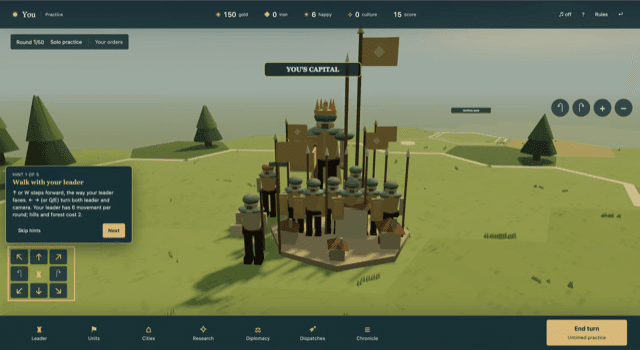 | |
| Screenshot of round 1 of a solo practice game in Leaders: the banner of You's capital on a hex plateau, the leader and a retinue of spear-carrying followers beside it, a hint card reading Walk with your leader, the relative movement pad, and a resource header showing 150 gold, 6 happy and 15 score | |
| Type | Turn-based strategy browser game |
|---|---|
| Inspired by | Sid Meier's Civilization V |
| Developer | David |
| Written in | React 19, Vite, Three.js, TypeScript, Cloudflare Workers, D1 (SQLite), Drizzle, zod |
| Tests | 158 unit tests, 5 Playwright browser scenarios |
| Built with | A near-single prompt to OpenAI Codex on GPT-6.1 Sol, then a controls, onboarding and deployment pass |
| Repository | DavidBrin/Leaders |
| Platform | Web browser (desktop and phone) |
| Released | October 2026 |
| Website | https://leaders.leaders-game.workers.dev |
Leaders is a turn-based strategy game for two to four players that runs in a web browser. It is played from behind a single leader standing on the ground rather than from a camera above a strategic map, and an order to a distant city or unit must be carried there by a messenger before it takes effect. Its author describes it as Sid Meier's Civilization V "if it were played from the Leader's perspective", with attack formations added. It runs on Cloudflare Workers with a D1 database.[1]
Overview
A match occupies a seeded hexagonal world of 17 by 13 tiles, 221 in all, with one capital per civilization and a leader, a builder and an infantry unit apiece. Players act simultaneously within a round, and the server resolves production, growth, travel, messengers and research once everyone has ended their turn or the room's deadline of 60, 120 or 180 seconds expires. A host shares a six-character room code or an invitation link; a practice mode runs the same rules against a local opponent.[2]
Gameplay
The camera follows the leader and looks along the leader's heading: the arrow keys step forward and back or turn leader and camera together, and an on-screen pad offers all six relative hex directions. There is no scrolling strategic map, and reconnaissance reaches four tiles around friendly cities and units. Clicking explored ground lights the cheapest route to it with an arrival estimate, and a second click travels. Every unit has six terrain points of movement a round, seven for cavalry and scouts; followers march with each leader step and spend their own budgets.[2]
Orders are physical. A unit within three hexes of the leader accepts a move, improvement, follow, fortify, attack or formation order at once. Beyond it the same order dispatches a messenger, either the leader's personal one or a slot belonging to the nearest city, one per city level. A messenger covers six terrain points per resolution, delivers only on arrival, then walks back before its slot frees. Cities can produce more messengers, which join the leader's retinue.
Cities hold population, hit points, a food store, a production queue and their own local knowledge. Base yields are 3 food, 8 production plus 2 per population, 4 gold and 2 science, and a city works as many owned tiles within two hexes as it has population. Happiness falls from a starting 8 with each city and every third citizen, and unhappiness halves any food surplus. Nine buildings, four trainable unit types and four improvements are available.
Research is local as well. Eleven technologies form a short prerequisite tree from agriculture and mining up to industrialization and scientific method, and every city researches independently and must be instructed in person or by messenger. A finished technology is known only to that city until free city messengers carry it to the others, so a new or captured city does not inherit the tree.
Combat is deterministic and positional: units have 100 hit points, and an adjacent attack spends all movement and inflicts damage with simultaneous retaliation. Five formations shape the result: line adds 15 percent to frontal defence, square 25 percent against frontal cavalry, wedge 25 percent attacking a line for 10 percent of its own defence, a cavalry flank 35 percent from off the defender's facing, and encirclement 30 percent with a friendly unit opposite. Only the strongest applicable bonus counts.
Diplomacy travels too: peace, trade and alliance offers and declarations of war walk to a rival capital and take effect only on delivery, and a trade holds 20 gold in escrow until accepted or refunded. A match ends by conquest, on score at round 50, or by a scientific victory for the first player holding three cities with a research laboratory and knowledge of scientific method.
Development
The first playable version was produced on 1 October 2026 by OpenAI Codex running the model GPT-6.1 Sol, from what its author calls a near-single prompt: one run researched the subject, wrote the design specification, implemented engine, client and server, commissioned independent reviews and deployed to a free tier. A second pass on 2 October 2026, made with Claude, reworked the controls and the hosting, adding heading-relative movement with a following camera, a highlighted route preview in the manner of Civilization, cheaper opening technologies, first-session hints, coloured territory borders, clickable units, a uniform six-point movement budget so followers march with the leader, producible messengers, and the durable Cloudflare deployment.[3]
An integrated correctness and security review reproduced three bugs, each fixed behind a failing regression: an ignored trade offer that prevented war indefinitely, remote travel validation that leaked hidden enemy positions, and two tabs on one seat losing distinct commands. It ships with 158 unit tests, 5 Playwright browser scenarios.[3]
Technology
The client is React 19 built with Vite, with a Three.js renderer; the rules live in a pure TypeScript engine that returns a new state for each action, applied only by an authoritative Cloudflare Worker. The renderer sees only a filtered per-player view, so map seeds, hidden terrain and rival economies never reach a browser. Room documents are revisioned rows in a D1 SQLite database reached through Drizzle, with requests validated by zod and a conditional update on the revision.[1]
Scope
The game is deliberately compact, and its documentation says so. There is no naval warfare, no religion, no espionage and no span of historical eras; the eleven technologies, nine buildings, four trainable units, five formations and 50-round cap are the content in full, not an attempt at the whole Civilization V catalogue. All graphics are original procedural meshes and textures generated in code, with no art extracted from the commercial game.[3]
See also
References
- Browser games
- Turn-based strategy video games
- 2026 video games