Island Empire (replica)
1 language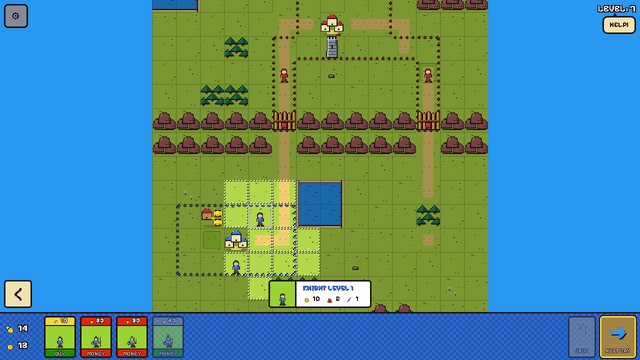 | |
| Screenshot of the Island Empire replica: a campaign level with a selected knight and the blue HUD bar | |
| Type | Turn-based strategy game |
|---|---|
| Replica of | Island Empire |
| Developer | David |
| Written in | Next.js 16, canvas renderer with code-drawn pixel art, PGlite (local) / Neon (production) |
| Tests | 434 unit and property tests, 25 e2e |
| Built with | Six research lanes, five build slices, eight codex review rounds |
| Repository | ../island-empire |
| Website | https://island-empire-david.vercel.app |
Island Empire (replica) is a browser rebuild of Island Empire, a mobile territory-conquest game by HBRZ-Developer (2020) descended from Sean O'Connor's Slay and the Android game Antiyoy. It was developed in the island-empire folder of the Replicates repository and ships a twelve-level campaign, random maps against a computer opponent, hot-seat play for up to eight players, weekly challenges and a map editor whose maps are shared by link.
Overview
The original publishes no rulebook, so the replica's rules were read off the game's store screenshots and three walkthrough videos. The most consequential finding contradicted every written source: reviews and the game's genealogy describe a hexagonal grid, but the frames show a square grid with four-neighbour adjacency, shield badges that never appear on a diagonal, and walls that protect only their own tile while a city protects the four around it.[1]
Rules
Land is divided into provinces of at least two connected tiles, each with a city that banks the province's gold. Every owned tile pays one gold a day, a farm pays five, a mine eight and a chest ten once. Knights of level one to four cost 10, 20, 30 and 40 gold and cost 2, 5, 12 and 30 a day in upkeep; a province that cannot pay loses every knight to a grave. A knight captures a tile only when its level strictly exceeds the tile's defence, and two knights merge into one of the summed level. The first two knight levels, the woodwall and the farm were read from unit cards; the level-three and level-four upkeep and the stone tower are extrapolations the decision log labels as such.[2]
Architecture
The game engine is a pure TypeScript module: apply(state, action) returns a new state and a list of events, and a layering test scans the source to reject any import of React or the DOM and any call to Math.random or the clock. The computer opponent, the random-map generator and undo (a replay of the turn's history from a snapshot) all live inside that boundary, so a whole computer turn is computed synchronously and the session runner only animates it. Every sprite is drawn from code onto a 32-pixel canvas and blitted without smoothing; the repository contains no image assets.
Development
The replica was built from six research lanes, five build slices, eight codex review rounds: research lanes covered repository conventions, rules, modes, interaction, the Slay/Antiyoy genealogy and visual design, and five developers built the engine, renderer, content, persistence and setup screens in parallel against two contracts published before any rule was implemented. It carries 434 unit and property tests, 25 e2e.[3]
See also
References
- Software replicas
- Turn-based strategy video games