Linear (replica)
1 language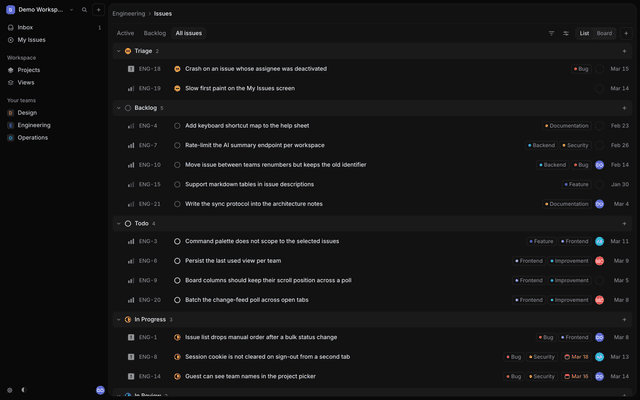 | |
| Screenshot of the Linear replica's issue list view | |
| Type | Issue tracking software |
|---|---|
| Replica of | Linear |
| Developer | David |
| Written in | Next.js 16, PGlite (local), Neon (production) |
| Tests | 1,559 unit tests, 23 e2e |
| Built with | Six research lanes, seven build slices |
| Repository | ../Linear |
| Website | https://linear-david.vercel.app |
Linear (replica) is a rebuild of Linear, the issue-tracking software, developed in the Linear folder of the Replicates repository. It reproduces Linear's issues, projects and teams, with membership enforced across four permission roles.
The replica adds a per-team DAG (directed acyclic graph) tab, a view the real product does not offer.
Overview
The replica covers issue tracking, project management and team membership across four permission levels. The interface was measured from the running Linear product rather than its marketing site. Its chrome uses a #09090a background around a #121213 pane, with colors taken from the live application.
Architecture
The status-glyph progress wedge is drawn at radius 1.94 rather than 2, a 3% shortfall observed in the measured product. Issue ordering uses fractional-index string comparison instead of Linear's own floating-point sortOrder field, since floats run out of double-precision headroom after roughly 50 inserts into a single gap; the database declares collate "C" explicitly to keep that string ordering deterministic. Authorization is implemented as a single table checked exhaustively by the TypeScript compiler via satisfies, backed by a hand-transcribed 416-case test matrix.
Development
The replica is built on Next.js 16 with PGlite for local development and Neon in production. It carries 1,559 unit tests, 23 e2e according to its README.md, while the root repository's README gives the older figure of 1,314 unit tests and 9 e2e tests.[1] It was built across six research lanes, seven build slices.
Reception
The project's decision log records three automated code reviews that found 18, 20 and 7 issues respectively, including a CSS url() injection vulnerability reachable through label names, an invite endpoint that leaked a user's email address, and unthrottled scrypt-hashing endpoints.[2]
See also
References
- Software replicas
- Issue tracking systems